Before The Magic Flute: Did Clementi Borrow Mozart First?
by Alex Harvey
Introduction
Christmas Eve, 1781. The court of His Imperial Majesty Joseph II, emperor of the Holy Roman Empire.
Mozart was in Vienna, newly independent from Salzburg service and eager to make his way in the imperial capital. Clementi had arrived a few days earlier, already famous as a keyboard virtuoso from London. The occasion was the visit of the Russian Grand Duke Paul and Grand Duchess Maria Feodorovna, and Joseph II arranged an evening of musical entertainment for his guests.
This night of entertainment turned into one of the most famous keyboard contests of the eighteenth century: Mozart and Clementi, placed before the emperor and his visitors, were asked to play.
Clementi played his Sonata in B-flat major, Op. 24 No. 2 – a piece he must have composed relatively recently – and his Toccata in B-flat major, Op. 11. The meeting appears to have been courteous, although Mozart later wrote dismissively about Clementi in letters to his father and sister. He admitted to admiring Clementi’s technical brilliance, especially his playing in thirds, but attacked his taste, feeling, and musicianship. In Mozart’s telling, Clementi was a dazzling technician rather than a true artist.
“Clementi is a charlatan, like all Italians! He writes presto on a sonata, or even prestissimo and alla breve – and plays it allegro in 4/4 time; – I know it, because I have heard him.”
Charlatan or not, Mozart nevertheless seems to have remembered Clementi’s opening theme, and used it to open his most famous opera, The Magic Flute.
Clementi and The Magic Flute
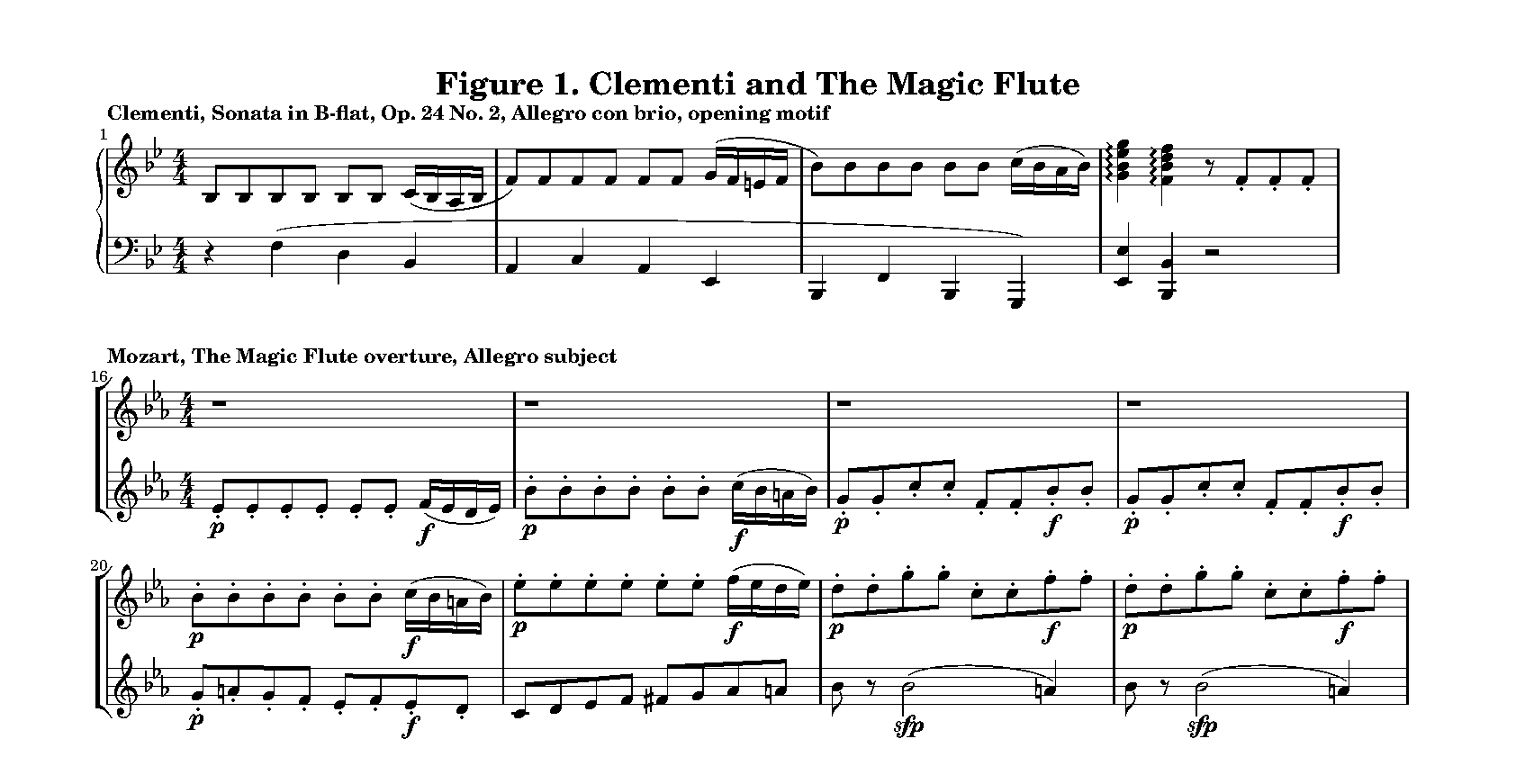
At least, Mozart took the first half of the motif, transposed it to E-flat major, and turned it into a fugue!
That is the familiar story: Clementi plays the sonata before Mozart in 1781; Mozart sneers at Clementi afterward; ten years later Mozart reuses Clementi’s opening idea in The Magic Flute. The direction of travel is simple enough: Clementi to Mozart.
But when I first played Clementi’s Sonata in B-flat major, I heard something else too: not The Magic Flute, but another Mozart work.
Mozart’s Sonata in B-flat major, K. 281
Clementi’s distinctive arpeggiated E-flat and B-flat major chords in measure 4 seem to quote the opening of Mozart’s third sonata in B-flat:
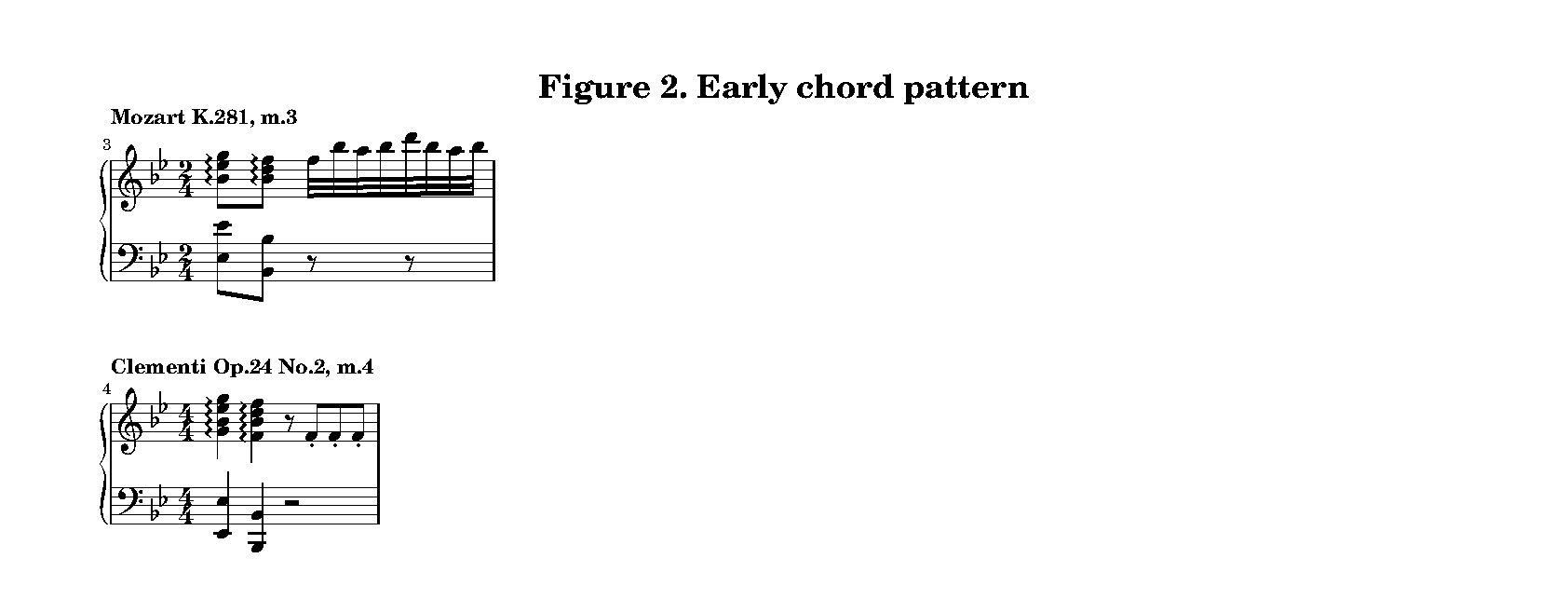
By itself, this could easily be just a conventional turn from the keyboard music of the 1770s. At first I thought no more of it.
But then other details piled up.
What if the borrowing did not run only one way? What if Clementi’s B-flat sonata was not only the source of Mozart’s later borrowing, but had also borrowed from Mozart?
Mozart composed his sonata K. 281 in Munich in 1775. Like Clementi’s later sonata, it is in B-flat major and written in a “brilliant” keyboard style.
There is a serious historical difficulty, though, which I will come back to: Clementi could not simply have found Mozart’s sonata in print before the Vienna meeting.
That would matter historically. It would suggest Mozart’s mature keyboard music was influencing other composers earlier than the publication record alone would lead us to think.
But for now, let us focus on the score evidence.
Three More Distinctive Features
1. Rising Scale, Repeated Trill, and Fall
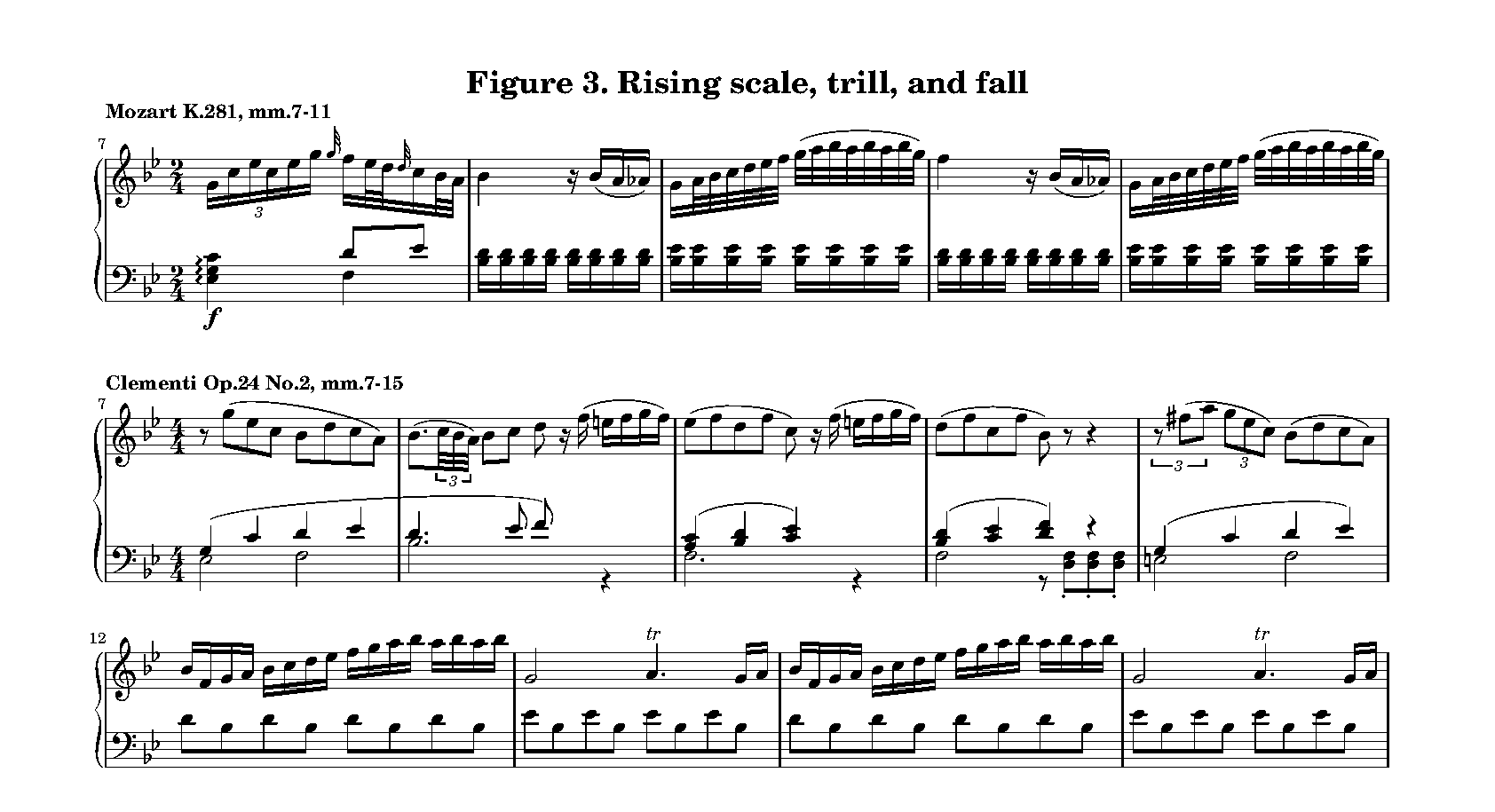
The most striking resemblance comes later in the exposition. Mozart’s passage in mm. 7-11 and Clementi’s passage in mm. 7-15 share much more than a general habit of writing scales or the key of B-flat major!
The opening left hand in Mozart’s m. 7 is almost identical to Clementi’s m. 7. The right hand in both then makes a descending melodic turn that leads to the same B-flat chord in m. 8.
Clementi’s next bar m. 10 then recalls the opening thirds of Mozart’s m. 1:
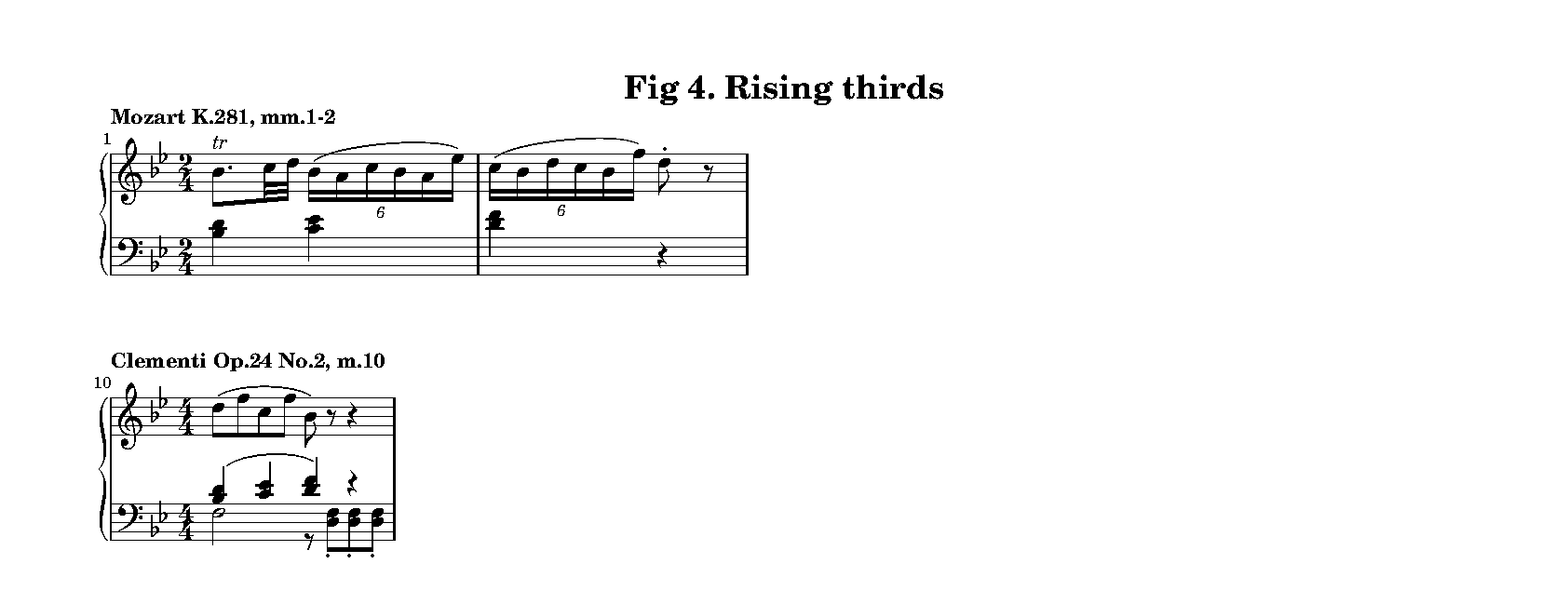
These are already quite specific correspondences.
Then comes a much larger shape: a fast, rising scale in B-flat major, ending in a measured trill of the same six notes, with the same accompanying chords, followed by a drop. This sequence catches the ear: ascent, brilliance, ornamental pressure, and then a downward release.
2. Descent, Low Chord, and Modulation to C Major
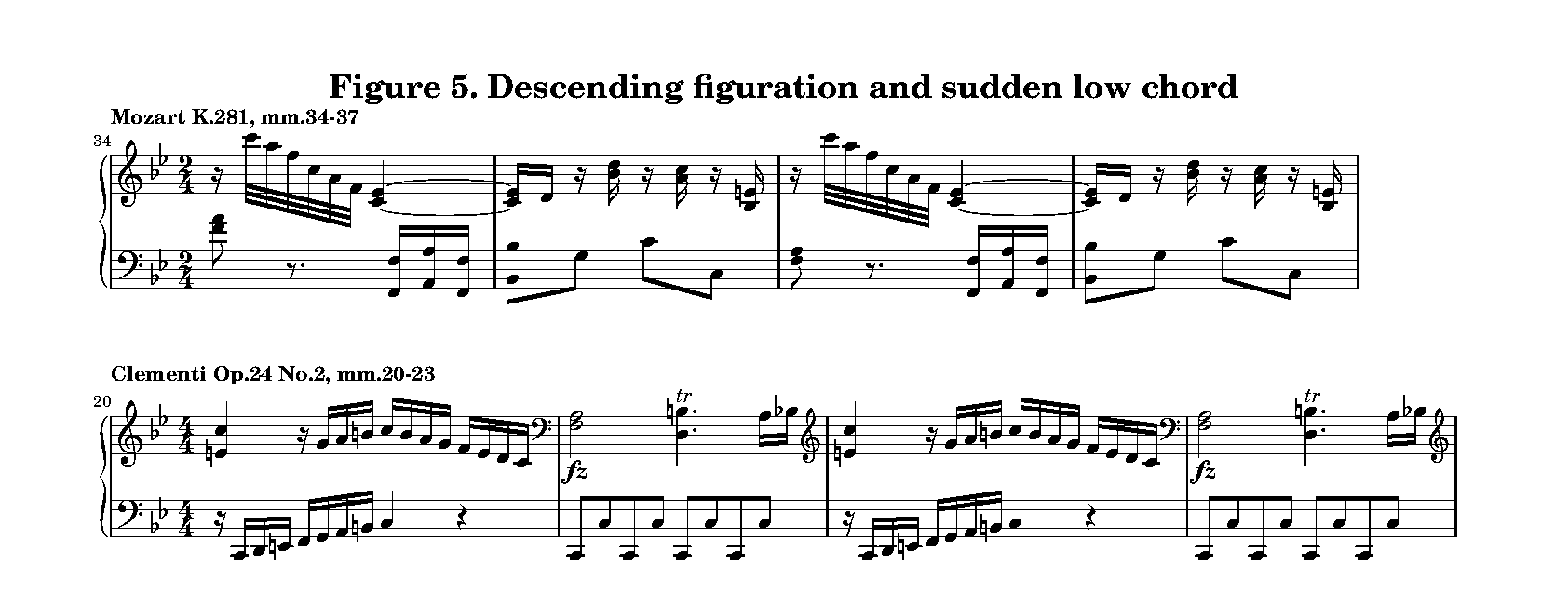
Another distinctive parallel occurs later, between Mozart’s mm. 34-37 and Clementi’s mm. 20-23. In each case, a rapid descent leaps suddenly to a low two-note chord on the first beat of the next bar. That low-register chord then leads to F major in second inversion, before the music reaches C major.
3. Clementi’s Development Section
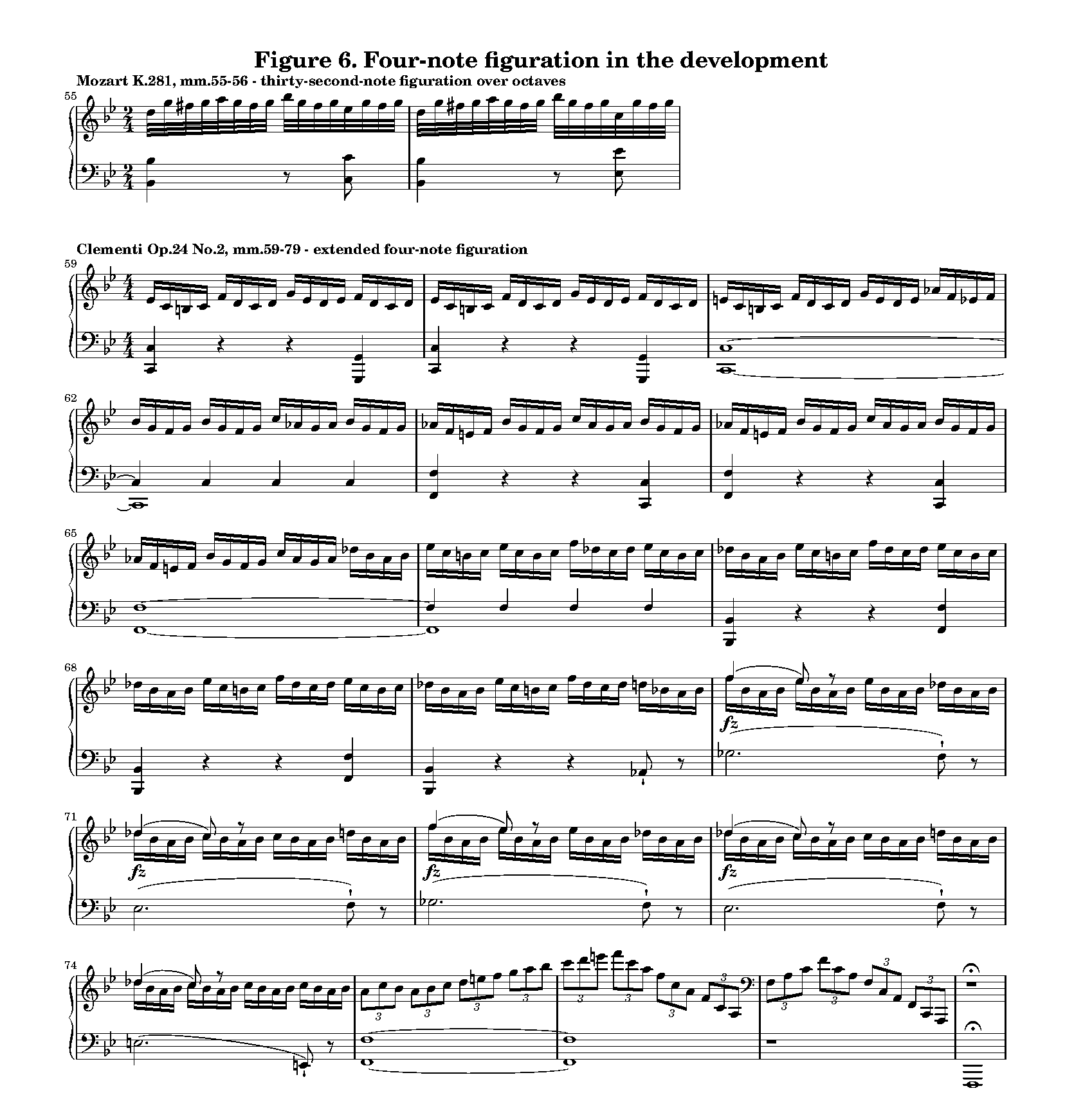
Late in Mozart’s development, at mm. 55-56, he briefly recalls a texture from his opening: rapid four-note right-hand figuration over left-hand octaves on the first and fourth beats.
Clementi seems to take up that passing idea and, from m. 59, builds a much larger developmental passage from it. Where Mozart had hinted at this texture, Clementi makes it do real work.
Coincidence, Common Style, or Allusion?
The obvious objection is that these may all be common classical or galant keyboard formulas. Brilliant figuration, thirds, arpeggiation, scale patterns, dramatic register shifts? All belong to the shared language of late eighteenth-century keyboard writing.
That objection matters because Mozart was not inventing this language from nowhere. His early sonatas belong to a broader contemporary sonata world, and the Mozarteum catalogue notes their relationship to Haydn’s Esterházy sonatas. A number of features in K. 281 also resemble Haydn’s Sonata in E-flat major, Hob. XVI:25. So some of the likenesses here may reflect a common idiom rather than direct knowledge of Mozart’s sonata.
But the case does not depend on one feature. What matters is an accumulation of a number of resemblances, in a piece in the same key and genre, in comparable positions within the work. Clementi’s sonata does not merely share a key and a few generic details with Mozart’s; it touches it at several points: early chordal punctuation, thirds, near-identical opening left-hand writing in the later phrase, rising scale and repeated-trill rhetoric, descent to a low chord and C major pedal, and developmental figuration.
I cannot personally believe this is all coincidence. The question is whether this pattern is better explained by shared style or by direct acquaintance with K. 281.
Could Clementi Have Known K. 281?
Here the argument becomes more difficult.
Mozart was famous in London from childhood. The Mozart children performed there in 1764-65, and by 1765 Mozart’s abilities as performer and composer were publicly discussed in London. Mozart’s early keyboard sonatas K. 10-15 were published in London in 1765, although these were accompanied keyboard sonatas, not the later solo sonatas.
Clementi lived in England from the later 1760s and became active in London musical life in the 1770s. By the time he left for the Continent, he was a leading keyboard musician. It is therefore very plausible that Clementi knew of Mozart, and quite possible that he knew some early published Mozart music.
But the B-flat sonata is a harder problem. Mozart composed it in Munich in 1775, and it was not published until 1799. Clementi could not have obtained it through ordinary printed London circulation before 1781.
So if Clementi knew K. 281, the route must have been less direct. Mozart may have performed it privately or semi-publicly. A manuscript copy may have circulated. A patron, traveller, teacher, collector, or publisher may have seen or copied it. Clementi may even have encountered it during his continental travels before the Vienna meeting.
At the moment, that is only possibility, not proof. I know of no document proving Clementi knew the sonata, no Clementi letter saying so, and no early London publication that would solve the problem neatly.
But elite musicians often encountered music before publication, and Clementi was not an obscure amateur waiting for printed editions to arrive in shops. He was an ambitious professional virtuoso moving in precisely the world where unpublished music could circulate.
Why It Matters
The usual story has it that Clementi plays the sonata before Mozart in 1781; Mozart later borrows the opening motif for The Magic Flute.
But if Clementi had already borrowed from Mozart, the Magic Flute motif starts to look less like a simple act of theft and more like part of an exchange: Mozart returning a compliment, answering a piece that had already answered him, or perhaps feeling entitled to borrow from a sonata that had borrowed from him first.
It also changes the meaning of Clementi’s choice of piece. If Clementi knew Mozart’s sonata, then playing this particular B-flat sonata to Mozart could have been intended as a kind of flattery: a subtle way of saying, I know your work, I admire it, and I can answer it in my own language.
That would also make Mozart’s contemptuous comments about Clementi more interesting. If Clementi’s sonata really was answering Mozart’s, then Mozart’s reaction becomes harder to understand. Why did he react so sharply?
Conclusion
Nothing here is proven of course. The publication history makes the claim difficult. The score parallels make it worth asking. The goal is not to announce a verdict, but to invite a different hearing of a familiar anecdote. If Clementi is hiding Mozart in plain sight, perhaps other ears – and other archives – can help decide.